Skip Nav
X

Burrus Story


Burrus Seed History


Burrus Hybrids was founded in 1935 by two brothers who believed in the value of service and integrity. Still farm-family owned and managed over half a century later, Burrus Hybrids Seed has built on a tradition of growing excellence to become the successful regional hybrid seed corn supplier it is today. 


When a company stands the test of time through a launch on the coattails of the Great Depression, economic hardships and successes and the creation and utilization of inventions and innovations, it has attained a great deal. Burrus Hybrids Seed has had the right ingredients to fuel the successful, and growing, hybrid seed corn business that it is today.


The history of Burrus highlights the events, people, and places that contributed to the growth and prosperity of a family seed corn business. From the first planting of hybrid seed corn in 1935, to the formation of the Associated Growers in 1939, to the launch of an interactive website in 2003 and every farming modernization in between, the Burrus history is the result of hard work and commitment of dedicated men and women. Burrus Hybrids has truly stood the test of time as a trusted partner in the farming industry.


Founded by two brothers in 1935, Burrus Seed has truly stood the test of time as a trusted partner in the farming industry.


1919
A New Business Begins

Roy, 29, and Wilbur Burrus, 27, purchase farmland for $400/acre and trade farms with their father, Alexander Burrus. This land became the first farm for producing Burrus Hybrids and is still used today.

1935

Roy and Wilbur acquire enough foundation seed to produce one acre of hybrid seed production to sell to their neighbors and use themselves. It is new and untested, so one acre is all the Burrus brothers can gamble on.

1938

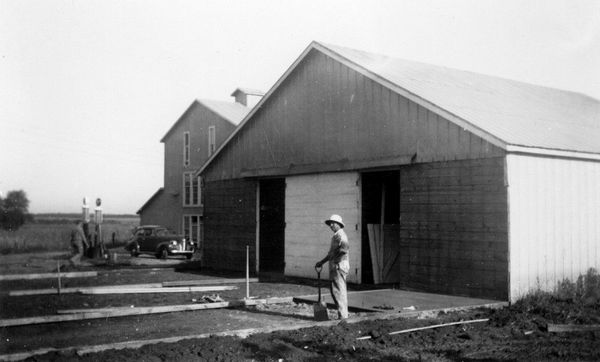
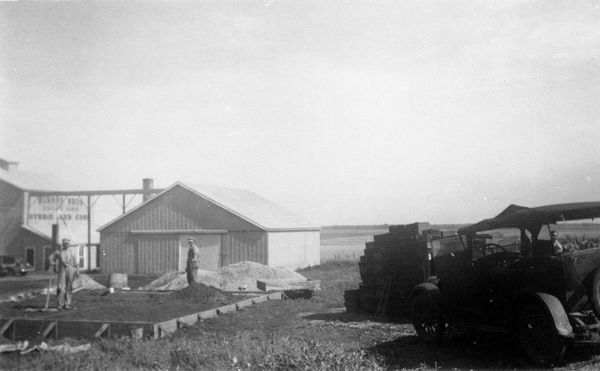
In the fall, the Burrus brothers borrow $10,000 to build a facility on the current site where they can shell, store, bag, and grade hybrid seed corn.


1946

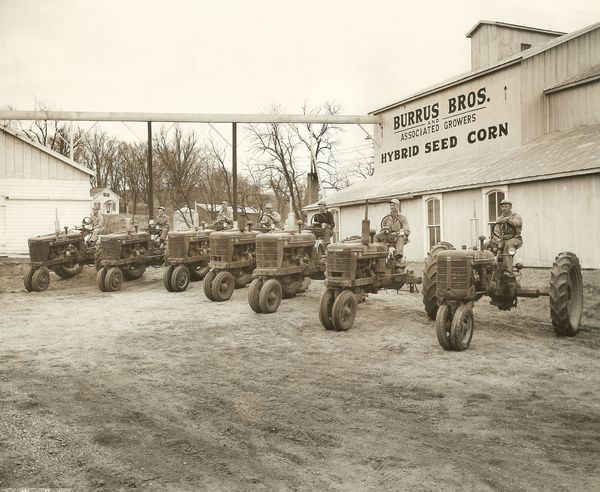
Burrus purchases its first detasseling machine, a Finco, which can carry six people to hand detassel a row per person.

1967

Burrus purchases Monier Seed Farms’ farmer-dealer organization.

Burrus begins selling 80,000-kernel units on single crosses only.

1972

Burrus introduces interplant seed production replacing the traditional 6:2 planting pattern. They plant female on every 38-inch row, and for every other pair of females, they put a male pollinator on a 19-inch center. Burrus learns to grow inbreds at high populations for them to yield. This system utilizes 100% of the land inside the isolation barrier rather than 75% in the old 6:2 system or 80% in the 4:1 planting pattern. Interplant also allows for better pollen distribution with the male never more than 19" away from a female plant.

1975

Burrus builds a concrete block dryer to fill the need for additional and more modern drying space.

1985

Burrus builds a new sizing tower. It has the ultimate in cleaning capabilities. It also features a potato chip elevator leg, called an Assecco leg, to minimize seed corn damage.

1992

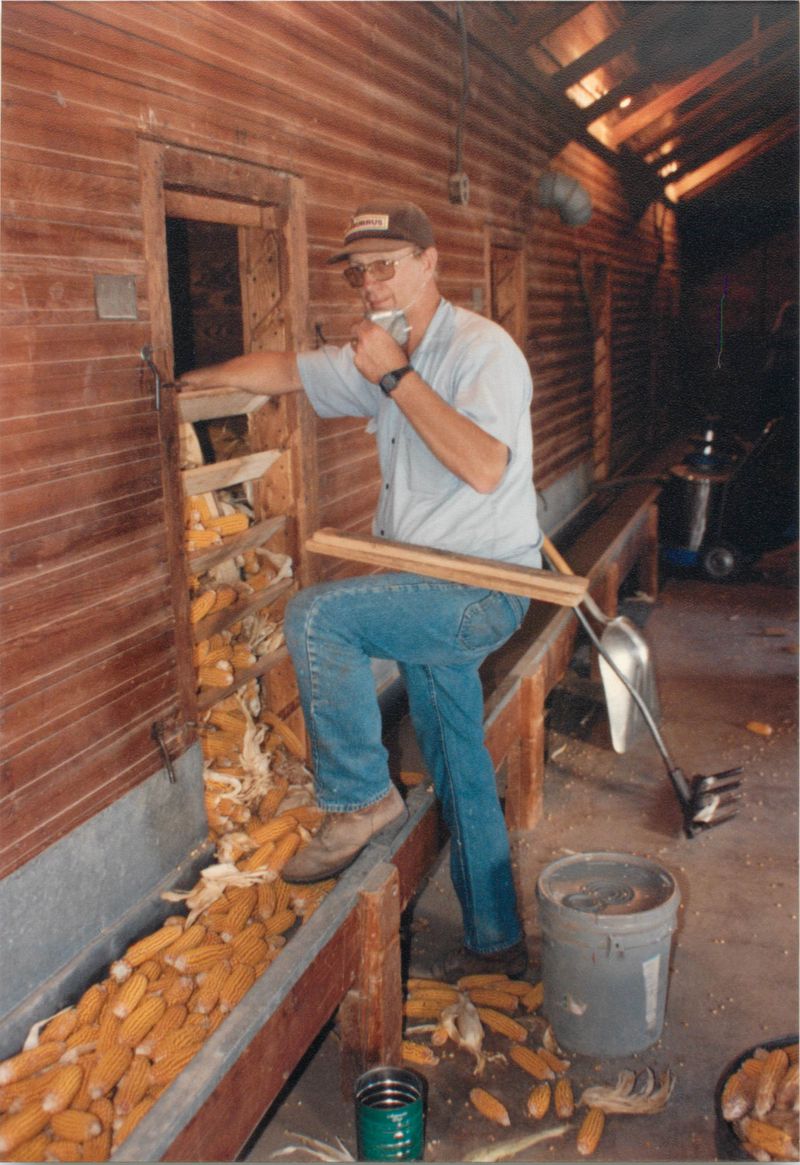
Burrus decides to increase their drying and sorting capacity. They go to a "husk-on" harvest and add a pit, husk and sort facility, dryer, and shuck accumulation area.

2004

Burrus makes major plant improvements by adding new technology. Satake color sorters make sorting seed more efficient and precise. Burrus also adds additional bagged warehouse space to facilitate its growing business.

2008

Burrus purchases Hoblit® Seed Company of Atlanta, IL, reaffirming the Burrus commitment to independence and to delivering quality products and services by strengthening the Burrus core strategy and positioning Burrus Hybrids for further market share growth.

2009

At the Burrus plant, a 16,800-square-foot refrigerator storage unit along with a new staging and dock area are added. The cold storage facility protects seed by maintaining a constant 50-degree temperature and 50% humidity to maximize germination.


2009 marks the first time a soybean Product Selection Guide is produced by Burrus and the first time a brand of seed corn other than Burrus – Hoblit – is offered for sale.

2010

A strategic alliance is created between Burrus and Hughes Hybrids of Woodstock, IL.

To facilitate their ever-growing soybean business, Burrus adds the Chillicothe, MO distribution location.

2011

Plant upgrades at the Arenzville facility include a new blending unit to make single-bag refuge products along with a new packaging line that features a robotic stacker and high-rate seed applied insecticide treating.

2013

Burrus purchases a Jacksonville, IL warehouse facility, adding an additional 70,000+ square feet of storage and office space.

2016

Downstream soybean treater added in Arenzville to enhance inventory management options.

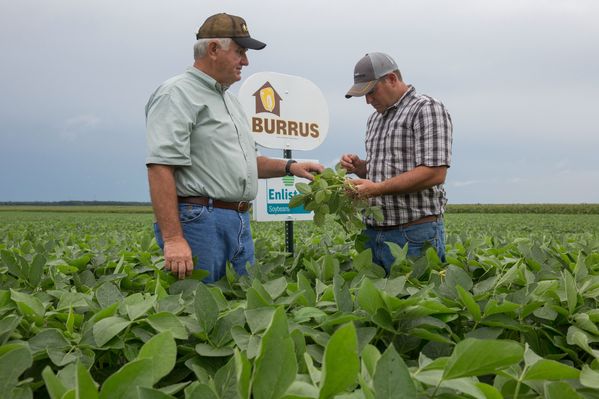
Participated in Dow’s Field Forward™ program, having the only Enlist E3™ field of its kind in Illinois.

2018

DONMARIO® brand soybeans are added to the product lineup for sale in 2019.

2022

Burrus expands their Jacksonville, IL campus by purchasing the adjacent property that includes additional warehouse and office space.

1919
1935
1938
1946
1967
1972
1975
1985
1992
2004
2008
2009
2010
2011
2013
2016
2018
2022

Historic News and Marketing

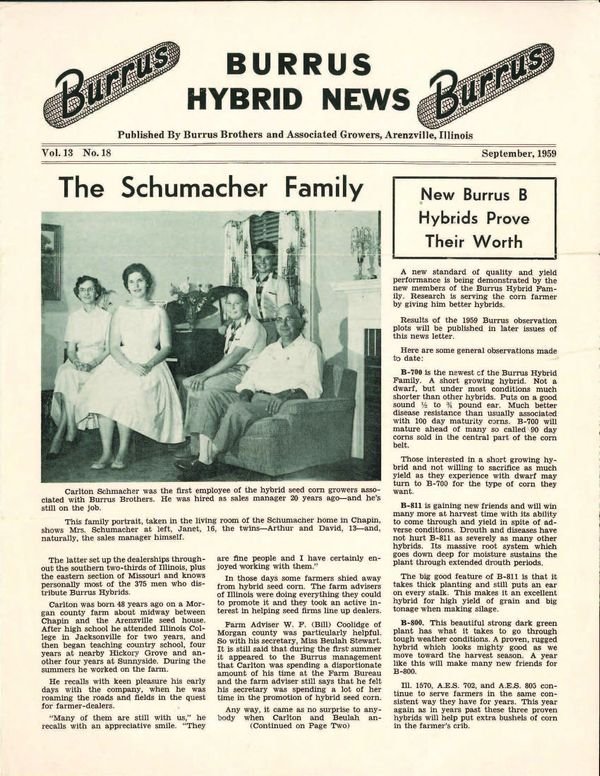
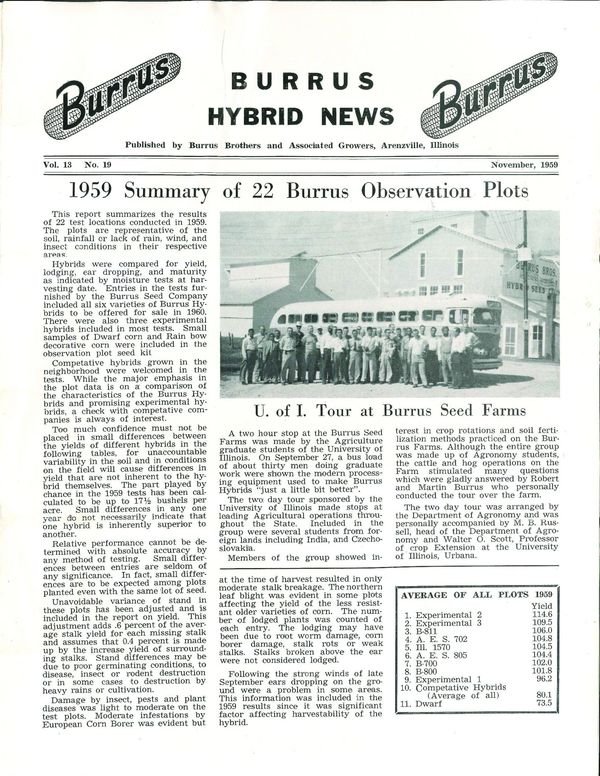
Burrus Seed has been sharing unbiased yield data and agronomic advice for 90 years! The goal of helping their neighbors increase their yield drove the creation of Burrus Seed. This same goal remains front of mind all these years later.

See Current News

When a company stands the test of time through a launch on the coattails of the Great Depression

Economic hardships and successes and the creation and utilization of inventions and innovations, it has attained a great deal. Burrus Hybrids has had the right ingredients to fuel the successful, and growing, hybrid seed corn business that it is today.


1st Generation
Founding Fathers

Roy Burrus, along with his brother Wilbur, founded Burrus Seed in 1935. They were pioneers in developing hybrid seed corn.

2nd Generation

Robert Burrus, along with his double cousin Martin, owned Burrus Seed until 1971 when Martin bought out Rob to make room for Martin’s sons, Tom & Todd.

3rd Generation

Tom and Todd Burrus both join the business upon graduating from Illinois College and the University of Illinois, respectively. 

4th Generation

Tom's son-in-law Tim Greene joined the business, first in  production, and later in sales and management. Todd's son Kevin Burrus and daughter Martha Krohe also joined the business leading the production and financial teams, respectively.

5th Generation

Tim Greene's sons, Griffin and Gannon both joined the company following their graduation from the University of Illinois. Griffin is currently an Account Manager and Gannon serves as Financial Lead.

1st Generation
2nd Generation
3rd Generation
4th Generation
5th Generation

The history of Burrus highlights the events, people, and places

That contributed to the growth and prosperity of a family seed corn business. From the first planting of hybrid seed corn in 1935, to the formation of the Associated Growers in 1939, to the launch of an interactive website in 2003 and every farming modernization in between, the Burrus history is the result of hard work and commitment of dedicated men and women. Burrus Hybrids has truly stood the test of time as a trusted partner in the farming industry.